Field note

DeepSeek-OCR reads documents as compressed vision tokens

Payments runs on documents - checks, wires, invoices, KYC files - and the OCR that reads them chokes on handwriting and damage. DeepSeek-OCR processes a page as roughly 100 visual tokens instead of a thousand text tokens, and it is open source. The headline accuracy comes with a compression ceiling worth knowing.

Oct 22, 2025 · Navin Agrawal · AI systems · 2 min read

DeepSeek-OCR reads documents as compressed vision tokens

Visual brief

Visual brief

DeepSeek-OCR reads documents as compressed vision tokens

As of October 2025

Payment systems run on images: check deposits, wire confirmations, invoices, remittances, KYC files, trade-finance paperwork. Current OCR chokes on handwriting, damage, and multilingual content, which is why so much still routes to manual review.

DeepSeek-OCR, released open source in October 2025, takes a different path. It reads a page as compressed visual tokens rather than a long string of text tokens, and the document volume in payments is exactly where that changes the economics.

Token compression

~10x

fewer tokens - a page needing about 1,000 text tokens encodes as about 100 visual tokens.

Precision

97%

decoding precision under 10x compression, falling to about 60% at 20x (DeepSeek-OCR report).

Throughput

200k+

pages per day on a single A100-40G GPU (DeepSeek-OCR report).

How it reads a page

The encoder pairs a SAM vision backbone for local detail with a CLIP backbone for global layout, joined by a 16x compressor. The decoder is a 3-billion-parameter mixture-of-experts that activates only about 570 million parameters per token. Fewer tokens carry the same information, and that is where the cost comes out.

Where it lands on benchmarks

At 100 vision tokens, DeepSeek-OCR surpasses GOT-OCR2.0 running at 256 tokens, and under 800 tokens it beats MinerU2.0, which averages over 6,000 tokens per page. It reconstructs tables and layouts that text-only systems flatten, and it handles handwritten amounts and damaged scans - the exact cases that send payment documents to manual review.
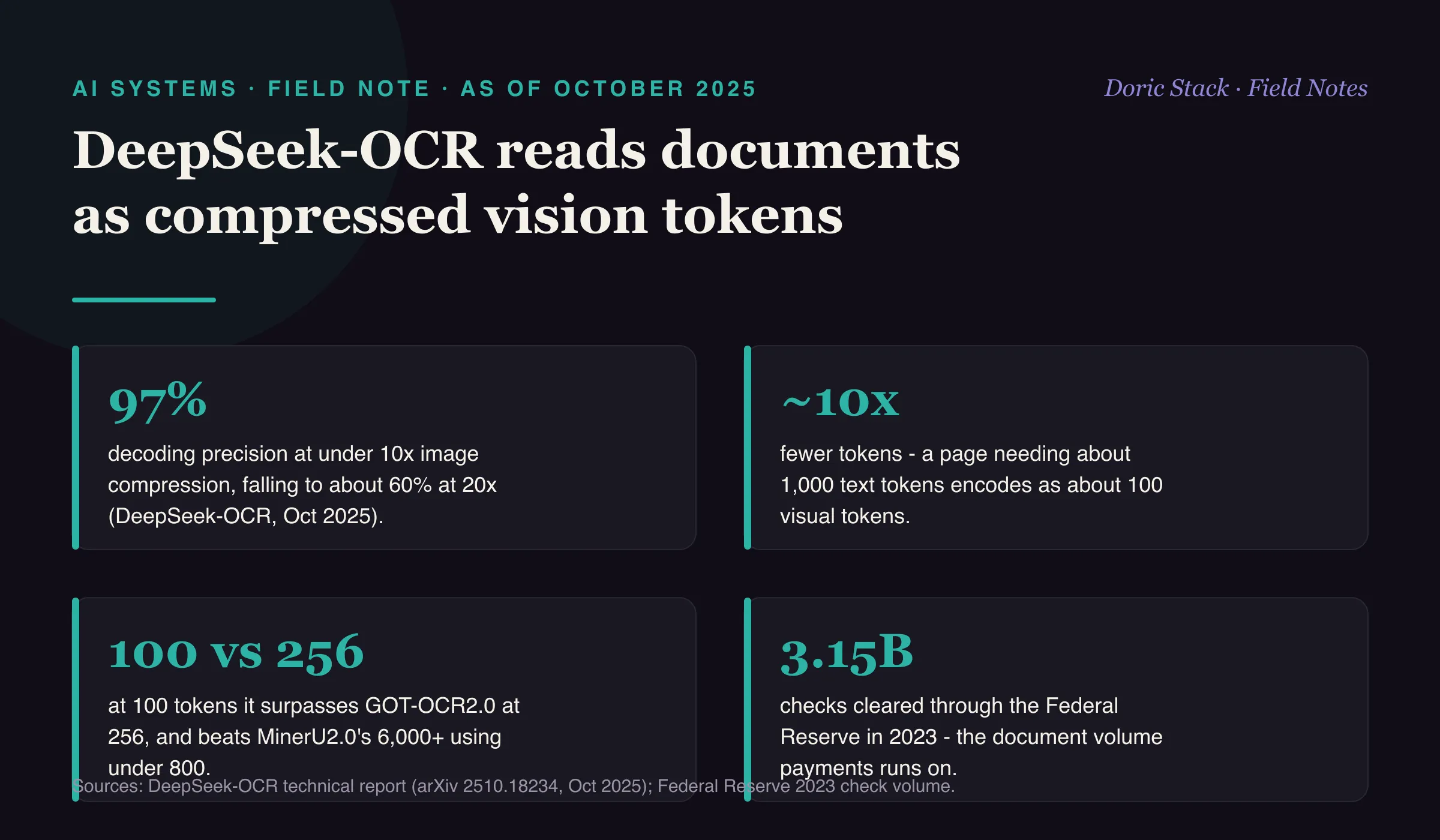
DeepSeek-OCR reads documents as compressed vision tokens (as of October 2025): a page needing about 1,000 text tokens encodes as about 100 visual tokens, roughly 10x fewer; the model holds 97 percent decoding precision under 10x compression, falling to about 60 percent at 20x; at 100 tokens it surpasses GOT-OCR2.0 at 256 and beats MinerU2.0's 6,000-plus using under 800; and the Federal Reserve cleared about 3.15 billion checks in 2023, the document volume payments runs on.
Same information in a fraction of the tokens, on an open-source model you can test against your own pipeline.
The constraint in banking AI was never model sophistication. It was the cost of reading millions of documents at scale while keeping accuracy and an audit trail.
Was this useful?

Choose once.

Related Posts

View All Posts »
Most AI agents never reach production. Payments is where that gets expensive

Most AI agents never reach production. Payments is where that gets expensive

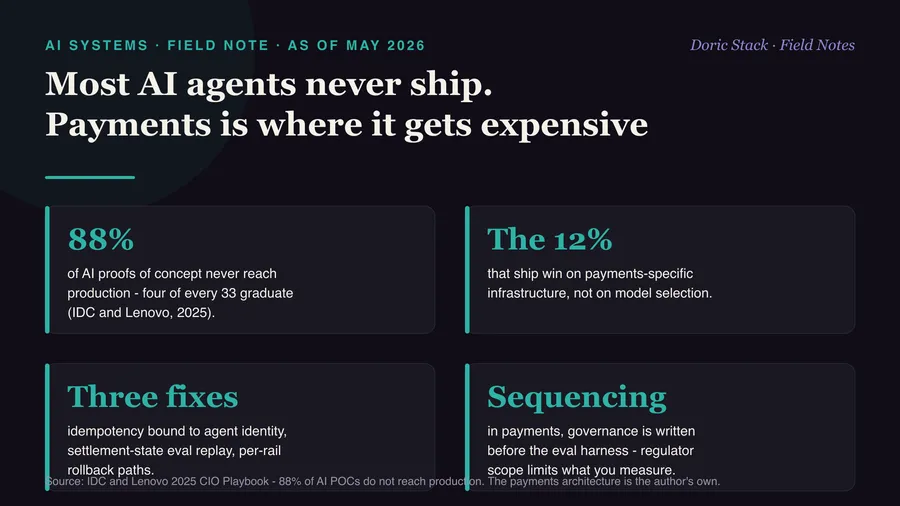
The widely cited figure is that 88 percent of AI proofs of concept never reach production. Agentic payments inherit that gap, and the teams that cross it are not winning on model selection. They are winning on payments-specific infrastructure that makes an agent idempotent, governable, and rollback-safe at the rail boundary.

Multi-model is the new multi-rail

Multi-model is the new multi-rail

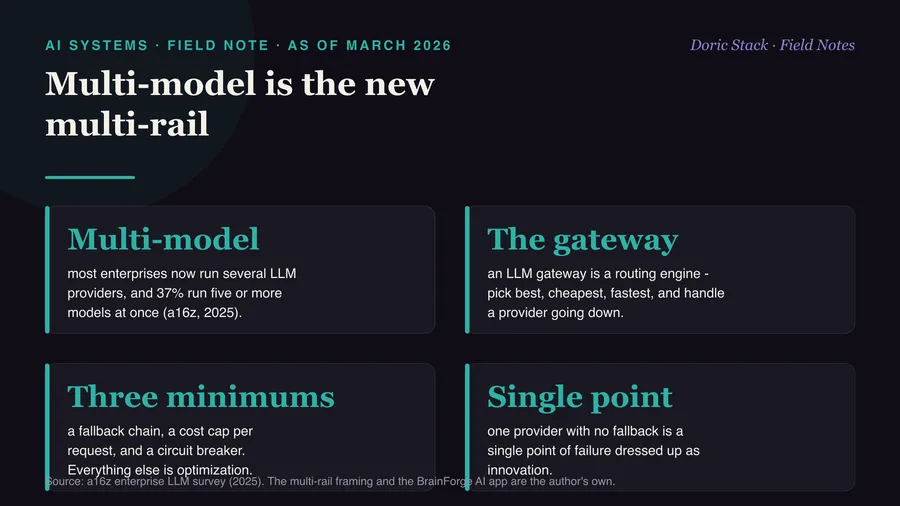
Every payment system routes across multiple rails - ACH fails, traffic moves to wire, and wire is dear for small amounts so you route to RTP. Most AI systems still call one model and hope it stays up. The LLM gateway is the same routing engine payments has run for decades, and it needs the same three things to count.

Agents do the wiring, architects carry the tradeoffs

Agents do the wiring, architects carry the tradeoffs

AI agents are arriving faster than most banking career ladders can adapt, and the market is already rewarding people who work with them. The career moat was never wiring up another API call. It is the judgment calls agents cannot own - which rail to trust, how much latency to spend, who the regulator will be.

AI agents can buy now, and fraud systems were not built for it

AI agents can buy now, and fraud systems were not built for it

Stripe, OpenAI, and Google shipped protocols that let AI agents complete purchases inside a conversation. The rails are already fast enough. The problem is that fraud detection was architected around a human clicking buy on a trusted surface, and agents break that assumption.