Field note

Payment platforms have docs. Almost none have a developer experience

Payment integration usually starts with a PDF, a sandbox that takes days to provision, and a support email that answers in 48 hours - and the third email is where patience dies and a competitor gets Googled. I built a self-service workbench to close the distance between what a platform can do and what a developer can figure out alone.

Mar 30, 2026 · Navin Agrawal · Architecture · 2 min read

Payment platforms have docs. Almost none have a developer experience

Visual brief

Visual brief

Payment platforms have docs. Almost none have a developer experience

As of March 2026

Every payment platform has API documentation. Almost none of them have a developer experience. Integration starts the same way: a PDF, a sandbox that takes days to provision, and a support email that answers in 48 hours.

Onboard enough partners and you learn the third support email is where patience dies and a competitor gets Googled. So I built a self-service workbench to remove that wait, and the friction it removes is the friction that actually loses integrations.

What it does

The workbench covers seven integration methods in one place - REST API, Forte.js tokenization, a mobile SDK, hosted checkout, secure web pay, NACHA batch, and card-present devices. If you do not know which one fits, a “Help Me Choose” flow asks six plain-English questions about your platform, your volume, and your PCI scope, then recommends a path. You pick a method, configure real credentials, run live transactions, and get code that works with your actual setup rather than generic samples from a docs page.

Not only for new builds

Existing clients can load their own credentials and test against sandbox or production. Debug a declined transaction, simulate error codes, verify a batch-file format, or ask the AI assistant an integration question in plain English. “How do I handle an ACH return” returns a working answer instead of a support ticket. The point is to let a developer get unstuck without waiting on a queue.

Integration paths

7 methods

REST API, Forte.js tokenization, mobile SDK, hosted checkout, secure web pay, NACHA batch, card-present.

Path finder

Help Me Choose

six plain-English questions about platform, volume, and PCI scope recommend the right path.

Output

Real code

configure credentials, run live transactions, and get code that works with your actual setup.
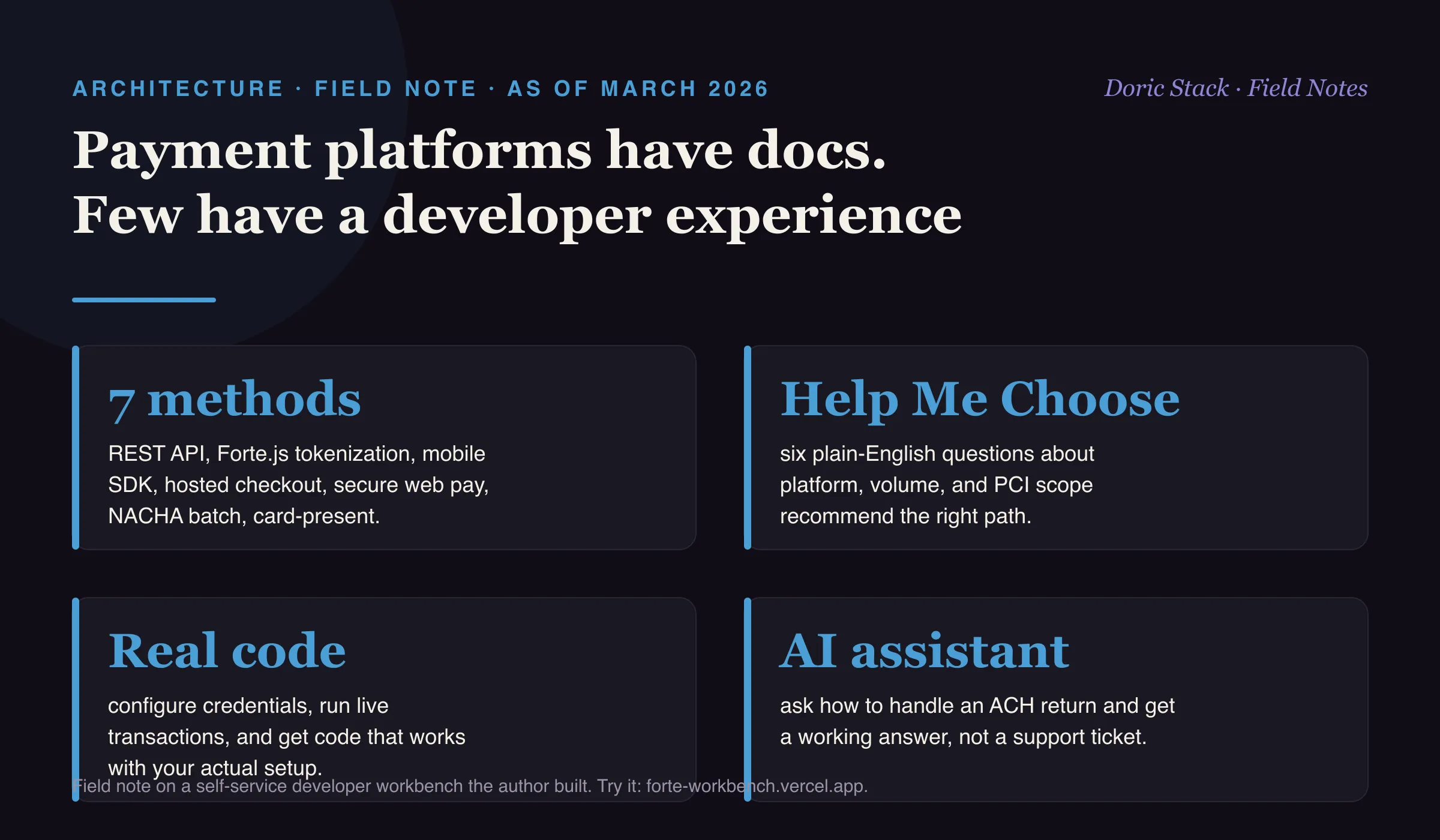
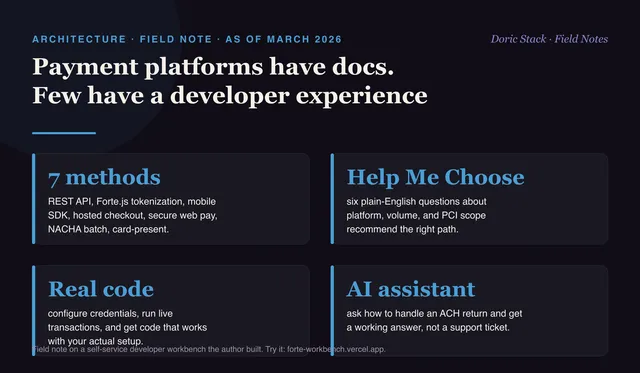
Payment platforms have docs, few have a developer experience (as of March 2026): a self-service workbench covers seven integration methods - REST API, Forte.js tokenization, mobile SDK, hosted checkout, secure web pay, NACHA batch, and card-present; a Help Me Choose flow asks six plain-English questions about platform, volume, and PCI scope to recommend a path; developers configure real credentials, run live transactions, and get code that works with their actual setup; and an AI assistant answers integration questions like how to handle an ACH return with a working answer instead of a support ticket.
A workbench that turns a PDF, a slow sandbox, and a 48-hour support email into a path you can run today.
Twenty-plus years on the architecture side of payments, and the hardest part was never the infrastructure. It was the distance between what the platform can do and what a developer can figure out alone.
Was this useful?

Choose once.

Related Posts

View All Posts »
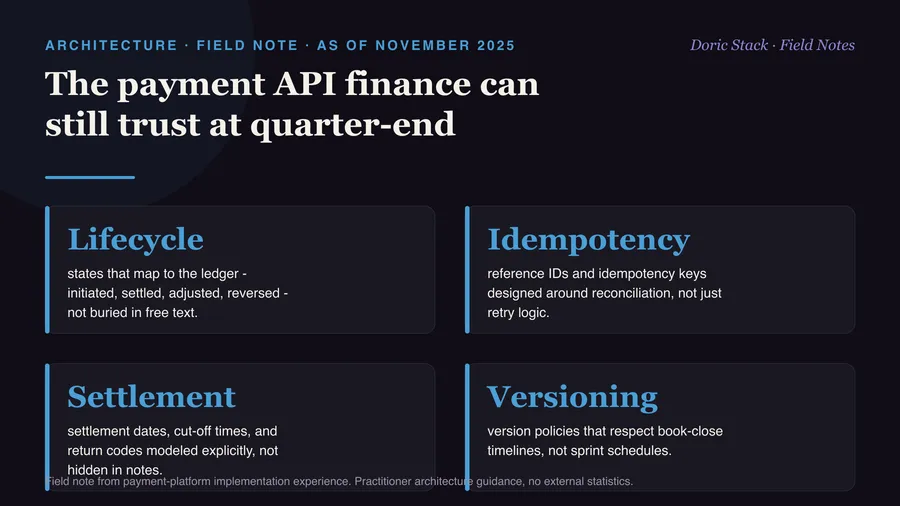
The payment API finance can still trust at quarter-end

The payment API finance can still trust at quarter-end

The API worked. The books did not. A clean REST interface with pretty JSON still leaves accounting stitching exports for three days to answer one question - what happened to this payment across every rail and every failure path. ERP-grade APIs treat the contract as a shared language with finance.

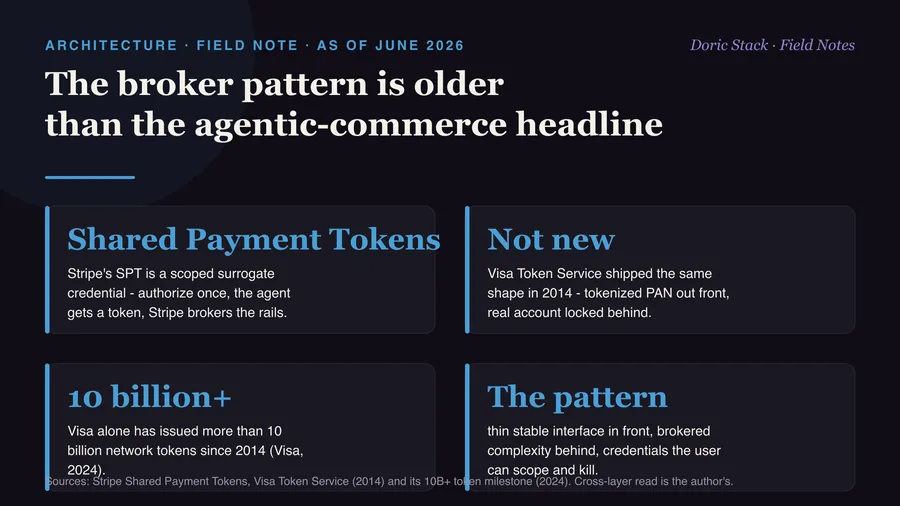
The broker pattern is older than the agentic-commerce headline

The broker pattern is older than the agentic-commerce headline

Stripe Shared Payment Tokens are the agentic-commerce headline, but anyone who ran a card tokenization rollout in 2014 recognizes the shape in five seconds. A scoped surrogate credential with a thin stable interface in front and brokered complexity behind is not new. Visa Token Service shipped it twelve years ago, and the architects who see the pattern early build the right systems instead of rebuilding every eighteen months.

BRICS does not need to kill SWIFT to change cross-border architecture

BRICS does not need to kill SWIFT to change cross-border architecture

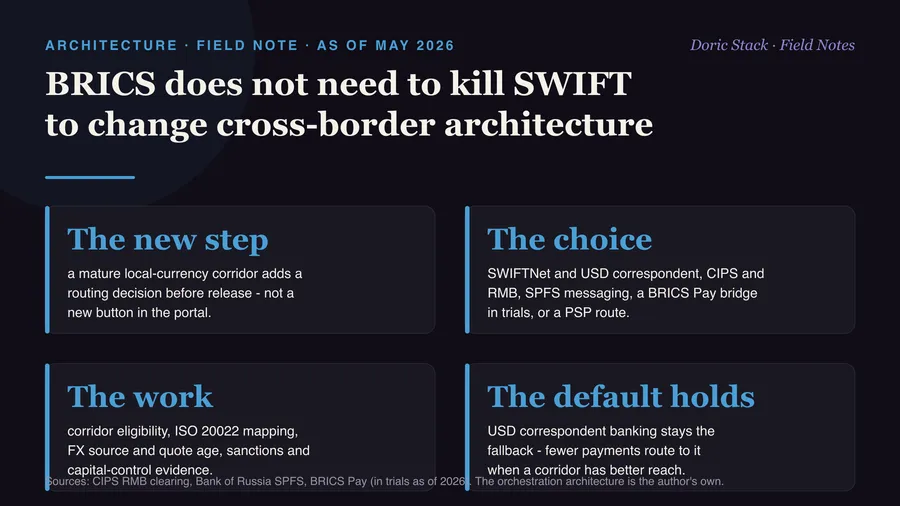
The interesting BRICS payments question is not geopolitics. It is architecture: when a US company pays a supplier in a BRICS country, does the payment still default to USD correspondent banking, or does the hub choose the corridor before release? A mature local-currency corridor adds a routing decision, and that decision is middleware, policy, liquidity, and evidence rather than a new button in the portal.

The 11:47am question real-time rails ask of your ledger

The 11:47am question real-time rails ask of your ledger

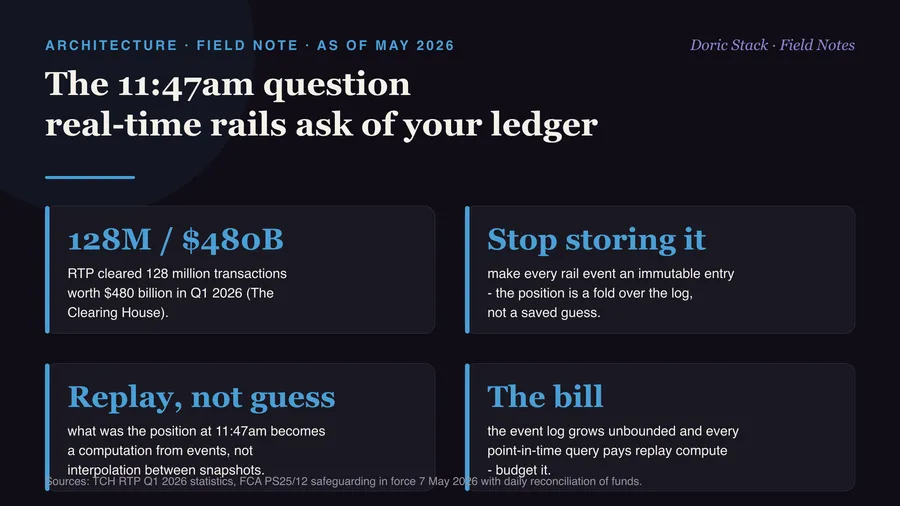
What was the cash position at 11:47am? On a snapshot-based model the honest answer is an interpolation between two saved states. Real-time rails turned that guess into a liability, and the fix is to stop storing a position at all and fold an immutable event log into the answer. The event log is not free, and most teams have not put the bill on the budget.