Field note

SpikingBrain bets on sparse firing over brute-force compute

Most large models keep every parameter lit for every token, like a city that never turns the lights off. SpikingBrain borrows the brain's trick - fire only the neurons that matter - and reports order-of-magnitude efficiency on Chinese MetaX chips. The headline numbers are real, with conditions worth reading.

Sep 18, 2025 · Navin Agrawal · Strategy · 2 min read

SpikingBrain bets on sparse firing over brute-force compute

Visual brief

Visual brief

SpikingBrain bets on sparse firing over brute-force compute

As of September 2025

Most large language models burn energy across millions of parameters that have nothing to do with the question in front of them. A spiking neural network does the opposite: neurons fire only when something relevant happens, and the rest stay silent.

The SpikingBrain technical report, out of a Chinese group in September 2025, puts hard numbers on what that buys. They are real figures, as long as you keep the conditions attached to each one.

Long-context speed

>100x

time-to-first-token speedup at 4M-token context versus a Transformer baseline (SpikingBrain report, Sep 2025).

MAC energy

97.7%

energy reduction in multiply-accumulate operations versus FP16, from sparse spiking activation.

Training data

<2%

of from-scratch training data - about 150 billion tokens via conversion-based continual pre-training.

What is verified

Two models, SpikingBrain-7B and a 76B mixture-of-experts, were trained and run on MetaX hardware with no NVIDIA chips in the loop. The 76B reaches performance comparable to Llama2-70B and Mixtral-8x7B, and the report measures about 69 percent activation sparsity, so most of the compute never fires.

What the headlines hide

The eye-catching figures carry conditions. “Over 100x faster” is time-to-first-token at a 4-million-token context, not general throughput. “97.7 percent less energy” is per multiply-accumulate operation against FP16, not wall-clock power draw. The efficiency is real, but it lives in long-context inference and sparse arithmetic, not everywhere at once.
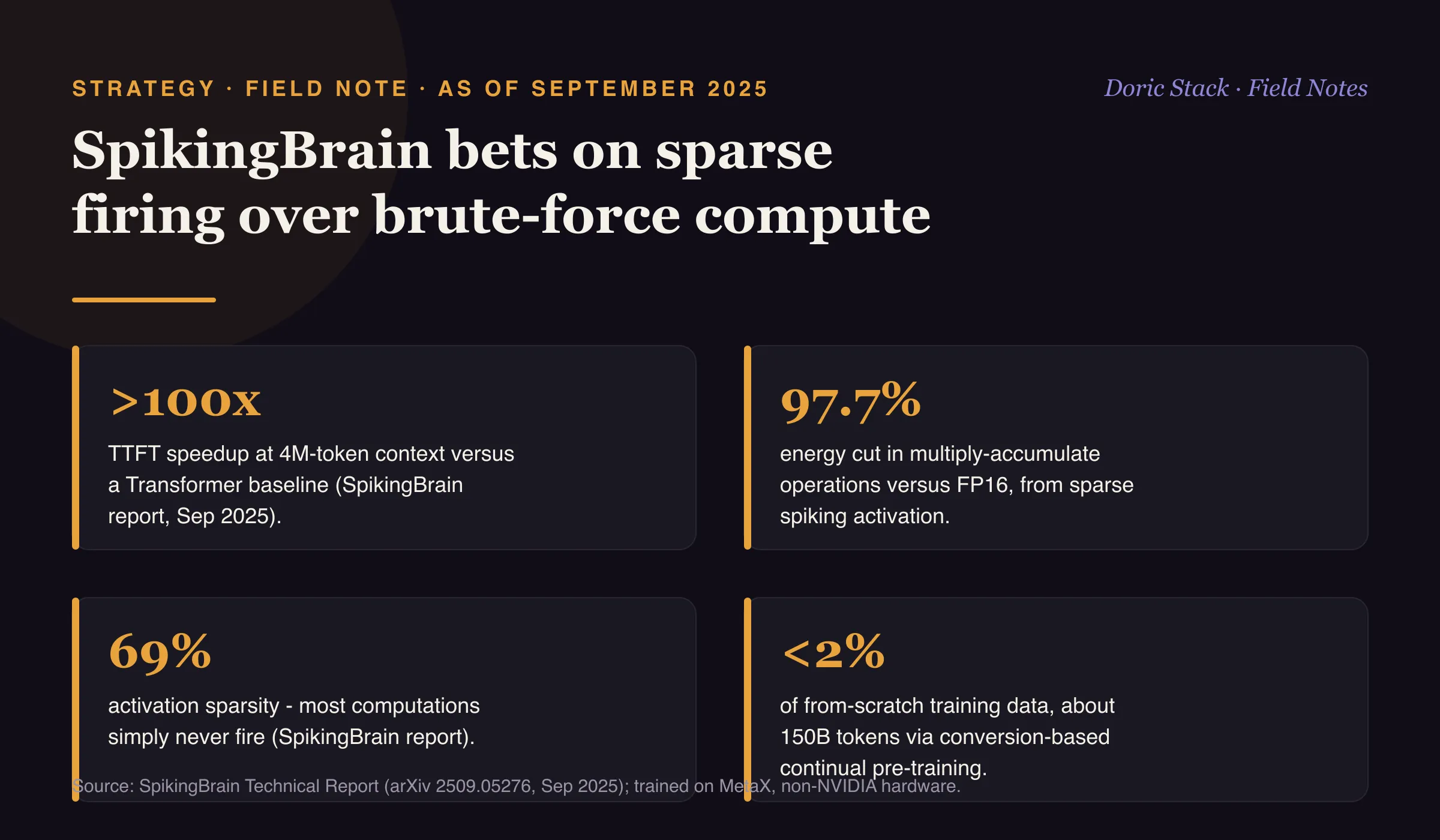
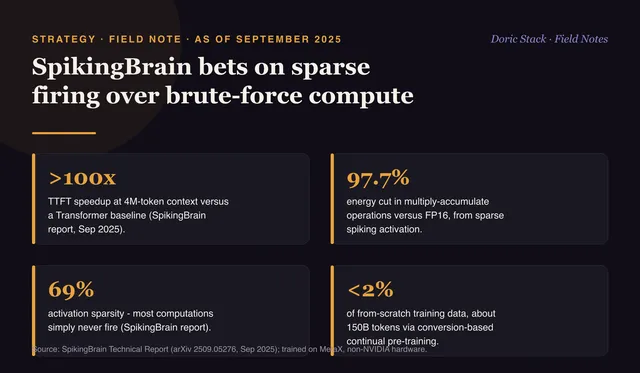
SpikingBrain bets on sparse firing over brute-force compute (as of September 2025): over 100x time-to-first-token speedup at 4-million-token context versus a Transformer baseline; a 97.7 percent energy reduction in multiply-accumulate operations versus FP16 from sparse spiking activation; about 69 percent activation sparsity, so most computations never fire; and under 2 percent of from-scratch training data, roughly 150 billion tokens via conversion-based continual pre-training, all on MetaX rather than NVIDIA hardware.
The savings are real where they apply: long-context inference and sparse arithmetic, on non-NVIDIA silicon.
The brain solved this millions of years ago - spend energy only where the work is. The interesting part here is doing it on hardware everyone assumed was inadequate.
Was this useful?

Choose once.

Related Posts

View All Posts »
BRICS payment rails are real, and they are at pilot scale

BRICS payment rails are real, and they are at pilot scale

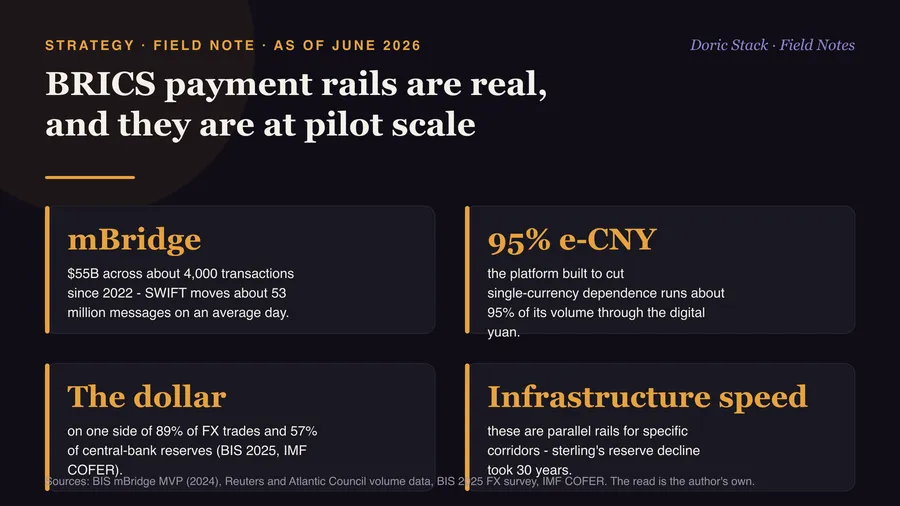
Five central banks are testing a settlement platform that does not touch SWIFT or the dollar. mBridge has been live since 2022, reached minimum viable product in mid-2024, and has moved about 55 billion dollars across roughly 4,000 transactions. SWIFT moves about 53 million messages on an average day. These are parallel rails for specific corridors, and infrastructure moves at infrastructure speed, not headline speed.

The core was never the bottleneck. The operating model was

The core was never the bottleneck. The operating model was

The plan said twelve months and the core replacement landed in year three. Nobody in that room was lying. They budgeted for a software install and got an operating-model change. After two decades on the payments, treasury, and integration side of these programs, here is the math I give clients before they sign a full legacy core replacement, and where the months actually go.

Real-time payments break your treasury org chart before they break your tech

Real-time payments break your treasury org chart before they break your tech

Your real-time rails settle in fifteen seconds. Your treasury org chart was built around an end-of-day cutoff. The gap between them is where the next reconciliation loss lives, and it shows up in three roles - cash positioning, exception ops, and intraday risk - long before it shows up in the tech stack.