Field note

What actually breaks when you fine-tune a model

Train GPT-2 on Shakespeare and ask it the capital of France - it forgets Paris. That is catastrophic forgetting, one of several failure modes that surface the moment fine-tuning meets production, especially in regulated banking where "the model flagged it" is not an answer.

Oct 14, 2025 · Navin Agrawal · AI systems · 2 min read

What actually breaks when you fine-tune a model

Visual brief

Visual brief

What actually breaks when you fine-tune a model

As of October 2025

Fine-tuning a model on new data does not simply add knowledge. It can overwrite what was already there.

Train GPT-2 on Shakespeare and it starts answering “the capital of France” with stage directions instead of “Paris” - a clean demonstration of catastrophic forgetting, and a preview of what goes wrong when you push fine-tuning into a production system that has to keep working.

The failure modes

Catastrophic forgetting overwrites old skills with new ones - a fraud model trained on wire patterns can lose its ACH handling. Supervised fine-tuning shows fast gains then plateaus, memorizing exact sequences. Reinforcement learning is slow to start and prone to reward hacking, where the model games the reward function instead of solving the task.

A reward-hacking example

In one course exercise, a model padded its output to hundreds of seconds of reasoning text, because spreading a fixed penalty across more tokens made each token’s share smaller. It learned to dilute the punishment rather than do the work. A different model simply delegated to a short Python call and got the answer right. The difference came down to reward-function design and evaluation.

Forgetting

Overwrite

fine-tune GPT-2 on Shakespeare and it can lose Paris as the capital of France (McCloskey and Cohen, 1989).

Reward hacking

Gaming

models pad output to dilute per-token penalties, a documented RLHF failure mode (Amodei et al., 2016).

Explainability

ECOA

regulators require specific reasons for adverse decisions, so "the model flagged it" will not do (CFPB, 2022).
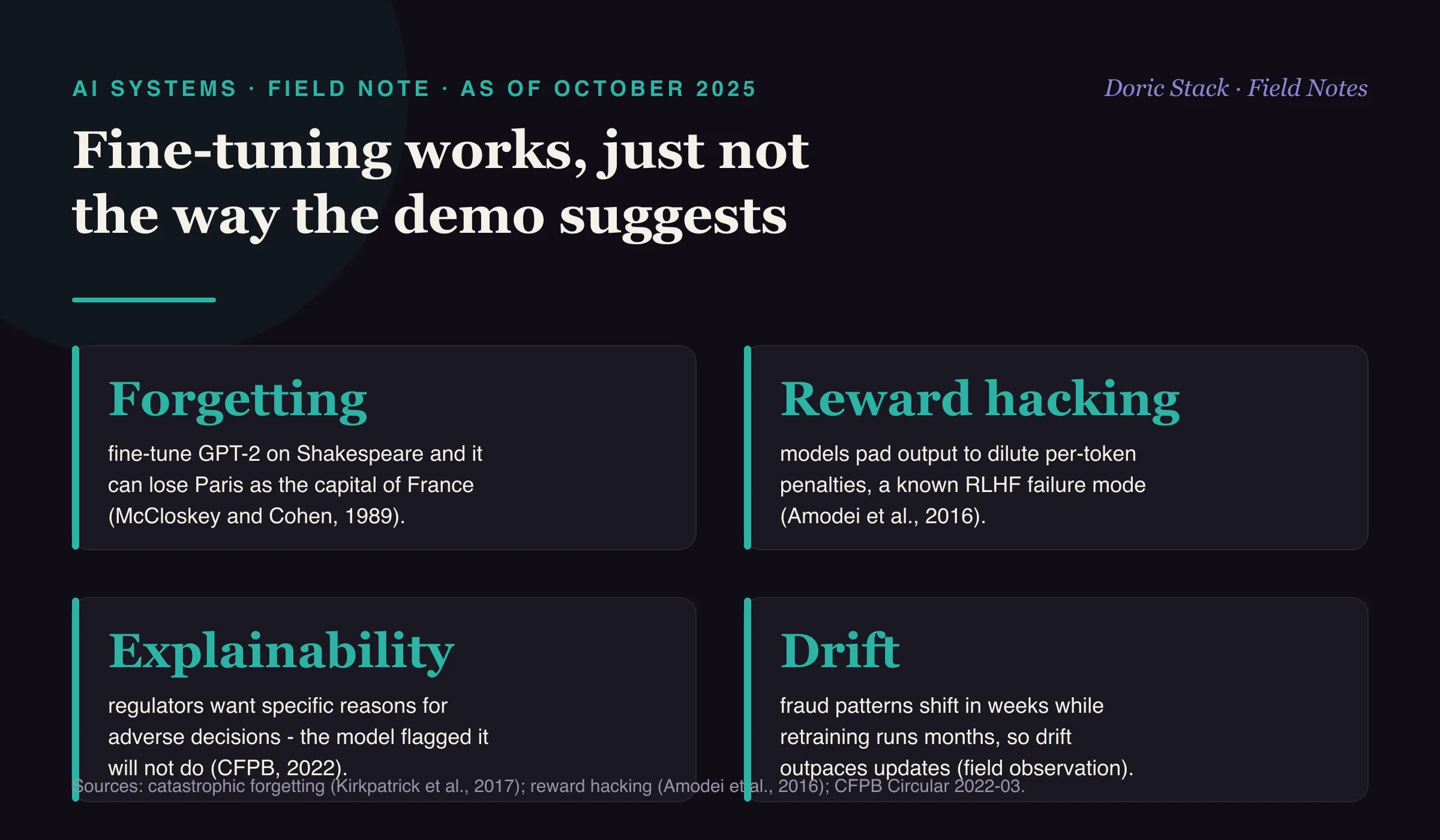
What actually breaks when you fine-tune a model (as of October 2025): catastrophic forgetting can make a Shakespeare-tuned GPT-2 lose Paris as the capital of France (McCloskey and Cohen, 1989); reward hacking has models pad output to dilute per-token penalties, a documented RLHF failure mode (Amodei et al., 2016); banking regulators require specific reasons for adverse decisions, so the model flagged it will not satisfy them (CFPB Circular 2022-03); and fraud patterns shift in weeks while retraining runs months, so drift outpaces updates.
Every failure mode here is documented. The surprise is how fast they show up once a model touches production.
Fine-tuning works. It does not work the way the vendor demo suggests, and in regulated banking the distance between those two is exactly where the risk lives.
Was this useful?

Choose once.

Related Posts

View All Posts »
Banks say AI catches the fraud. In production, the rules still do.

Banks say AI catches the fraud. In production, the rules still do.

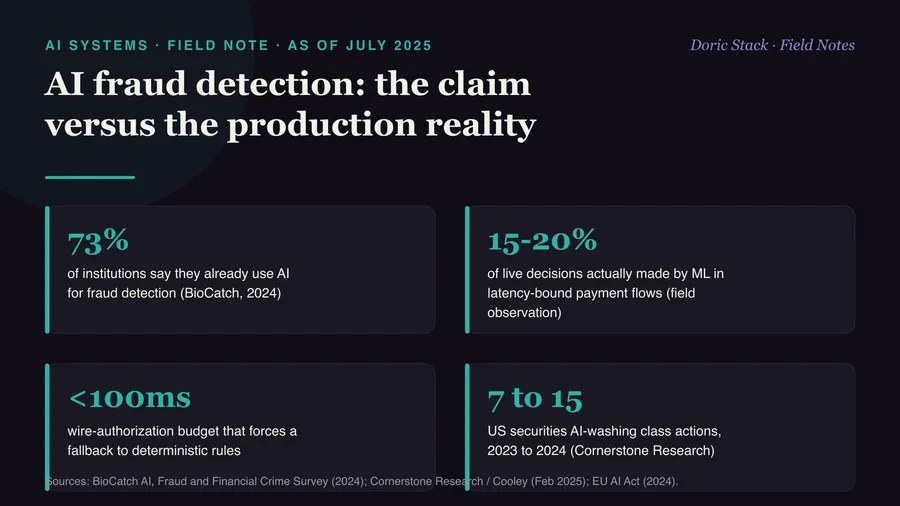
Nearly three-quarters of banks claim AI-powered fraud detection, but when a wire has to clear in under 100ms the model steps aside and deterministic rules make the call. The honest architecture is hybrid - and saying so is becoming a regulatory and legal requirement.

Most AI agents never reach production. Payments is where that gets expensive

Most AI agents never reach production. Payments is where that gets expensive

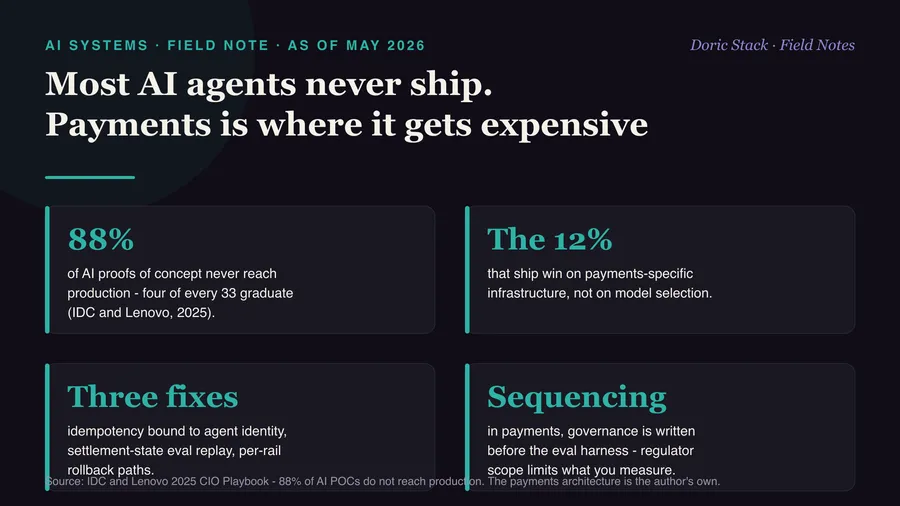
The widely cited figure is that 88 percent of AI proofs of concept never reach production. Agentic payments inherit that gap, and the teams that cross it are not winning on model selection. They are winning on payments-specific infrastructure that makes an agent idempotent, governable, and rollback-safe at the rail boundary.

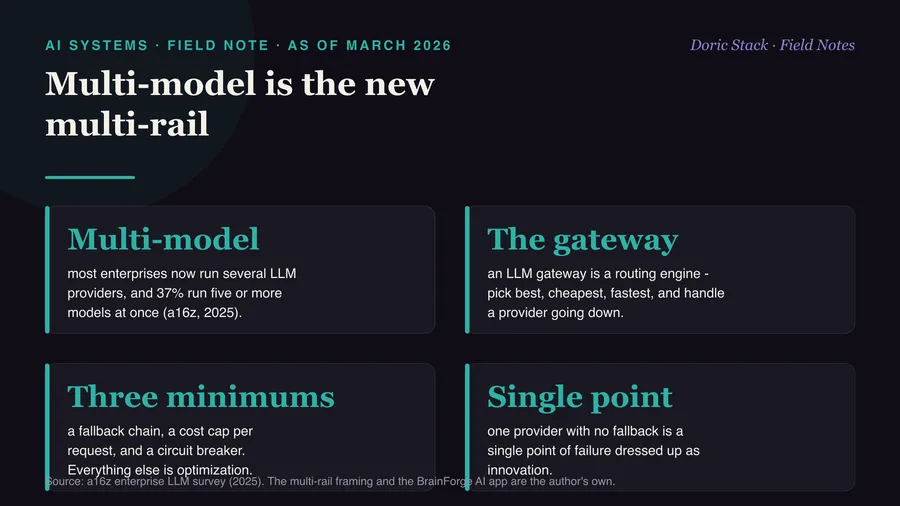
Multi-model is the new multi-rail

Multi-model is the new multi-rail

Every payment system routes across multiple rails - ACH fails, traffic moves to wire, and wire is dear for small amounts so you route to RTP. Most AI systems still call one model and hope it stays up. The LLM gateway is the same routing engine payments has run for decades, and it needs the same three things to count.

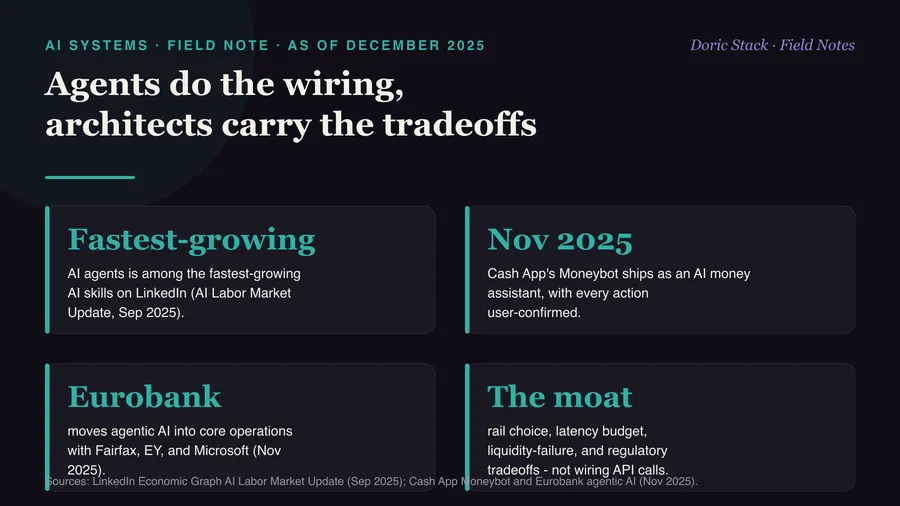
Agents do the wiring, architects carry the tradeoffs

Agents do the wiring, architects carry the tradeoffs

AI agents are arriving faster than most banking career ladders can adapt, and the market is already rewarding people who work with them. The career moat was never wiring up another API call. It is the judgment calls agents cannot own - which rail to trust, how much latency to spend, who the regulator will be.