Field note

ISO 20022 coexistence ends, and translation layers come due

Your bank says it is "ISO 20022 ready" for the November 22 cutover. Check the docs and it is usually a translation layer - MT to MX at the SWIFT boundary, MX back to MT inside. That is compliant, and it quietly throws away the structured data that was the whole point.

Nov 10, 2025 · Navin Agrawal · Payments · 2 min read

ISO 20022 coexistence ends, and translation layers come due

Visual brief

Visual brief

ISO 20022 coexistence ends, and translation layers come due

As of November 2025

Your bank's email says it is ISO 20022 ready for the November 22 cutover. Open the implementation docs and it is usually a translation layer: MT converting to MX at the SWIFT boundary, then back to MT for the systems inside.

That is technically compliant. It is also where the value leaks out, because the structured data ISO 20022 carries does not survive the round trip back into MT.

Coexistence ends

Nov 22

2025 end of CBPR+ MT/MX coexistence - MT payment-instruction messages retired cross-border (SWIFT).

Structured address

Nov 2026

unstructured postal addresses rejected at the network, with a structured hybrid address mandatory.

Free net ends

Jan 2026

SWIFT starts charging for contingency MT processing and in-flow translation.

What the translation layer drops

A structured remittance field rich enough to carry invoice detail gets flattened when it lands in an MT-based reconciliation system, and the treasury team goes back to manual matching. Enriched party identifiers with Legal Entity Identifiers that would make sanctions screening automatic get truncated, so compliance validates by hand what should have been automated. Structured exception codes the translation layer cannot interpret turn every edge case into a manual investigation.

The deadlines stacking up behind it

The architecture question banks deferred in 2023 and 2024 is now a multi-year problem. From January 2026, SWIFT starts charging for contingency MT processing and in-flow translation. From November 2026, unstructured postal addresses are rejected at the network. By November 2027, free-format investigation messages give way to ISO 20022 Case Management. The translation layer depends on exactly the things SWIFT is retiring.
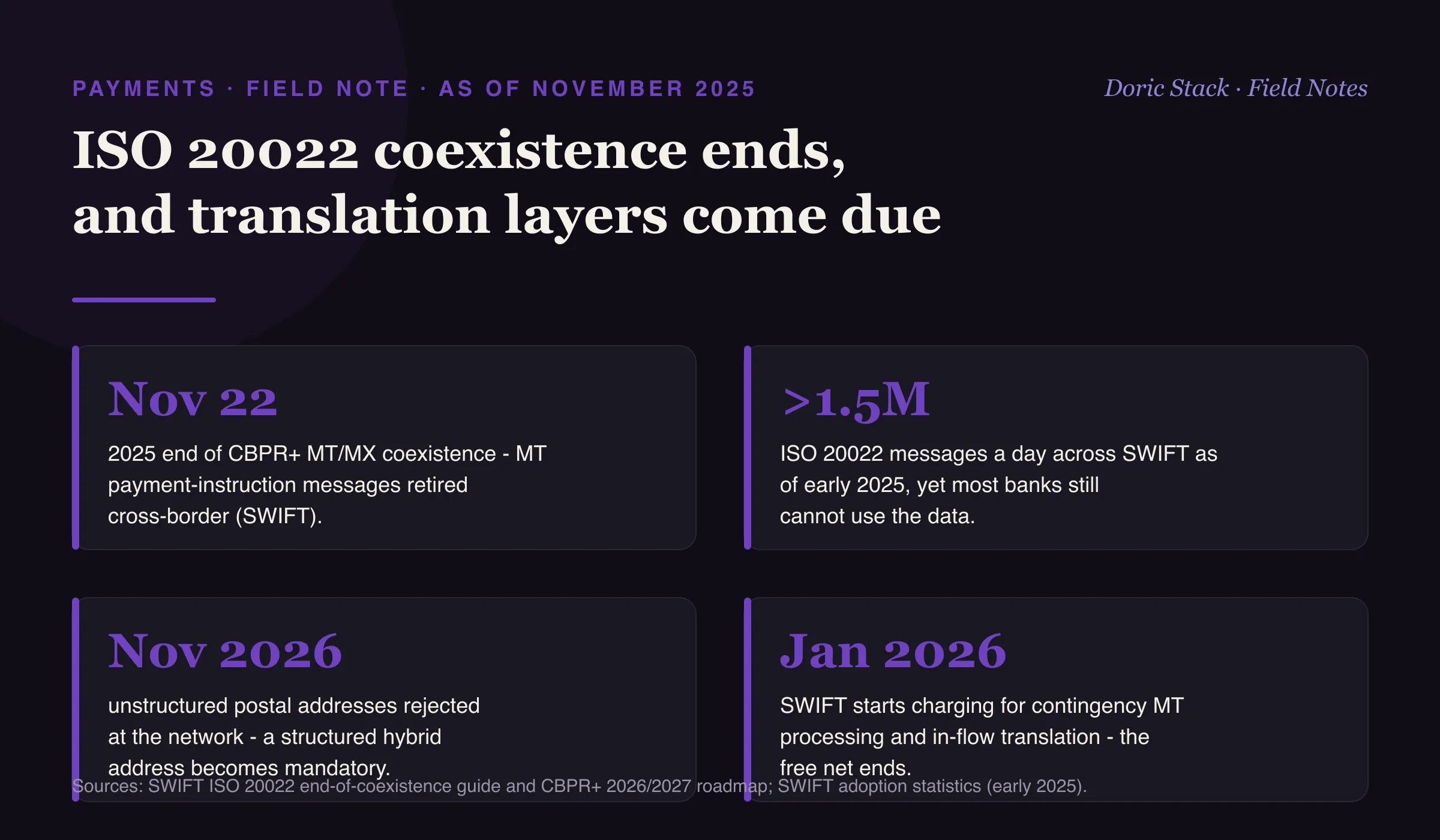
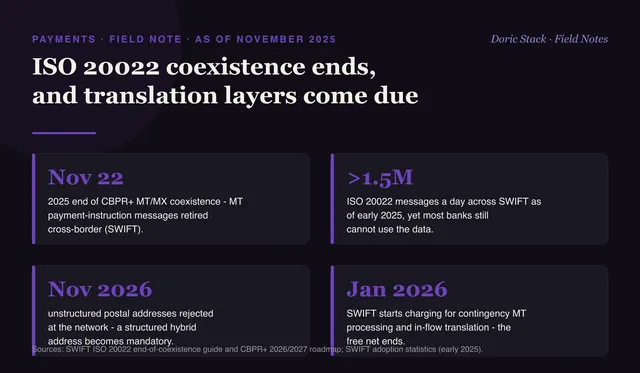
ISO 20022 coexistence ends and translation layers come due (as of November 2025): the CBPR+ MT/MX coexistence period ends 22 November 2025, retiring MT payment-instruction messages for cross-border use on SWIFT; more than 1.5 million ISO 20022 messages a day were flowing across SWIFT as of early 2025, yet most banks still cannot use the structured data; from November 2026 unstructured postal addresses are rejected and a structured hybrid address becomes mandatory; and from January 2026 SWIFT begins charging for contingency MT processing and in-flow translation, ending the free conversion safety net.
Compliance by translation buys the deadline and forfeits the data - right before SWIFT phases the translation path out.
Technical compliance and competitive advantage are not the same thing. The banks running native ISO 20022 already have the straight-through reconciliation the translation layer cannot deliver.
Was this useful?

Choose once.

Related Posts

View All Posts »
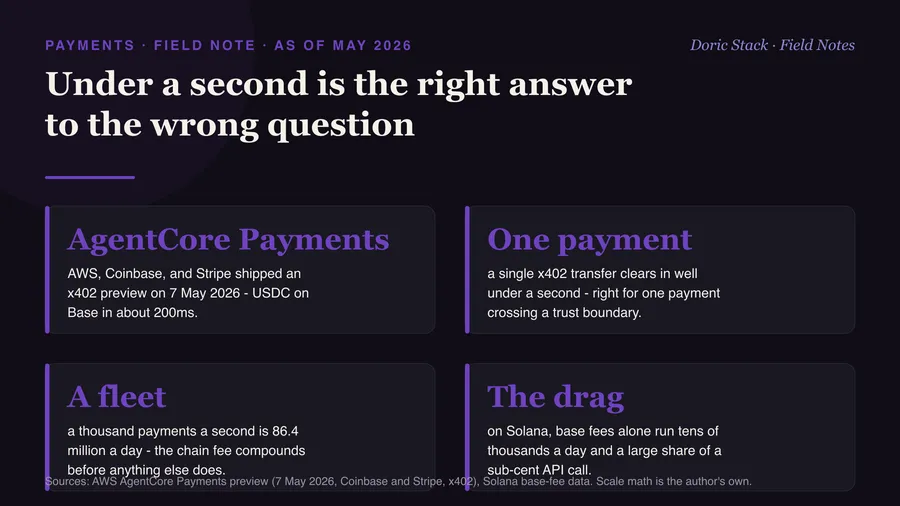
Under a second is the right answer to the wrong question

Under a second is the right answer to the wrong question

At an AWS Bedrock AgentCore Payments session the question was what happens at a thousand transactions a second, and the answer was settlement in under a second. Both are true and they answer different questions. The right frame for one payment crossing a trust boundary is the wrong frame for a million events a day inside one agent fleet, where the chain fee stacks up before anything else does.

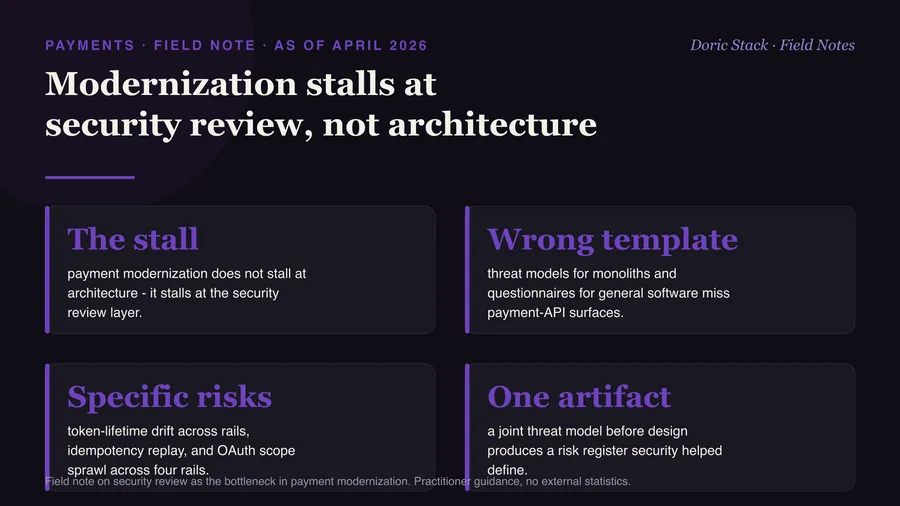
Payment modernization stalls at security review, not architecture

Payment modernization stalls at security review, not architecture

Payment modernization projects do not stall at the architecture layer. They stall at the security review layer - threat models built for monoliths, questionnaires written for general software, cycles tuned for annual releases. The teams that ship on time put security in the room before design, not after.

Stablecoin custody and issuance converge on one charter

Stablecoin custody and issuance converge on one charter

Two US regulatory threads just lined up. The GENIUS Act created a federal pathway to issue payment stablecoins, and the OCC's new rule lets national trust banks hold digital assets in non-fiduciary custody - then conditionally chartered Coinbase as one. Issuance and custody can now sit inside the same federally regulated counterparty.

A chartered bank just put a stablecoin on card settlement

A chartered bank just put a stablecoin on card settlement

SoFi Bank put SoFiUSD on Mastercard's settlement layer. Authorization still rides the card rails and the merchant sees nothing change, but the interbank fund movement happens on-chain, around the clock, with no batch window and no correspondent float. For the first time, issuers and acquirers get to choose their settlement medium.