Field note

Multi-rail is baseline now. The operational tax is the work

The multi-rail debate is over - most US banks enabling instant payments now run both RTP and FedNow. The cost moved from the strategy deck to the operations floor, where exception handling becomes a decision tree, reconciliation becomes real-time position-keeping across two liquidity models, and routing is a per-transaction decision in milliseconds.

Apr 28, 2026 · Navin Agrawal · Strategy · 3 min read

Multi-rail is baseline now. The operational tax is the work

Visual brief

Visual brief

Multi-rail is baseline now. The operational tax is the work

As of April 2026

Every bank running both RTP and FedNow eventually hits the same incident. The dashboard shows the payment settled, the customer says it never arrived, and the ops team cannot tell which rail to investigate first.

Multi-rail used to be a strategy debate. Per the US Faster Payments Council’s 2025 Faster Payments Barometer, 58 percent of US banks that have enabled instant payments now use both rails. The debate is over. The cost just moved from the strategy deck to the operations floor.

Three things change the moment you cross from one rail to two. Exception handling becomes a decision tree, because ACH return reason codes do not map to RTP reject reasons, and neither maps to FedNow’s response codes, and a FedNow Request for Return of Funds is not a wire investigation. Reconciliation becomes real-time position-keeping across two liquidity models, because RTP runs against The Clearing House’s prefunded joint account while FedNow settles directly against your Fed master account, both around the clock, so there is no end-of-day position anymore. And routing stops being configuration: it is a per-transaction decision across cutoffs, limits, beneficiary preference, and bank capability, all evaluated in milliseconds.
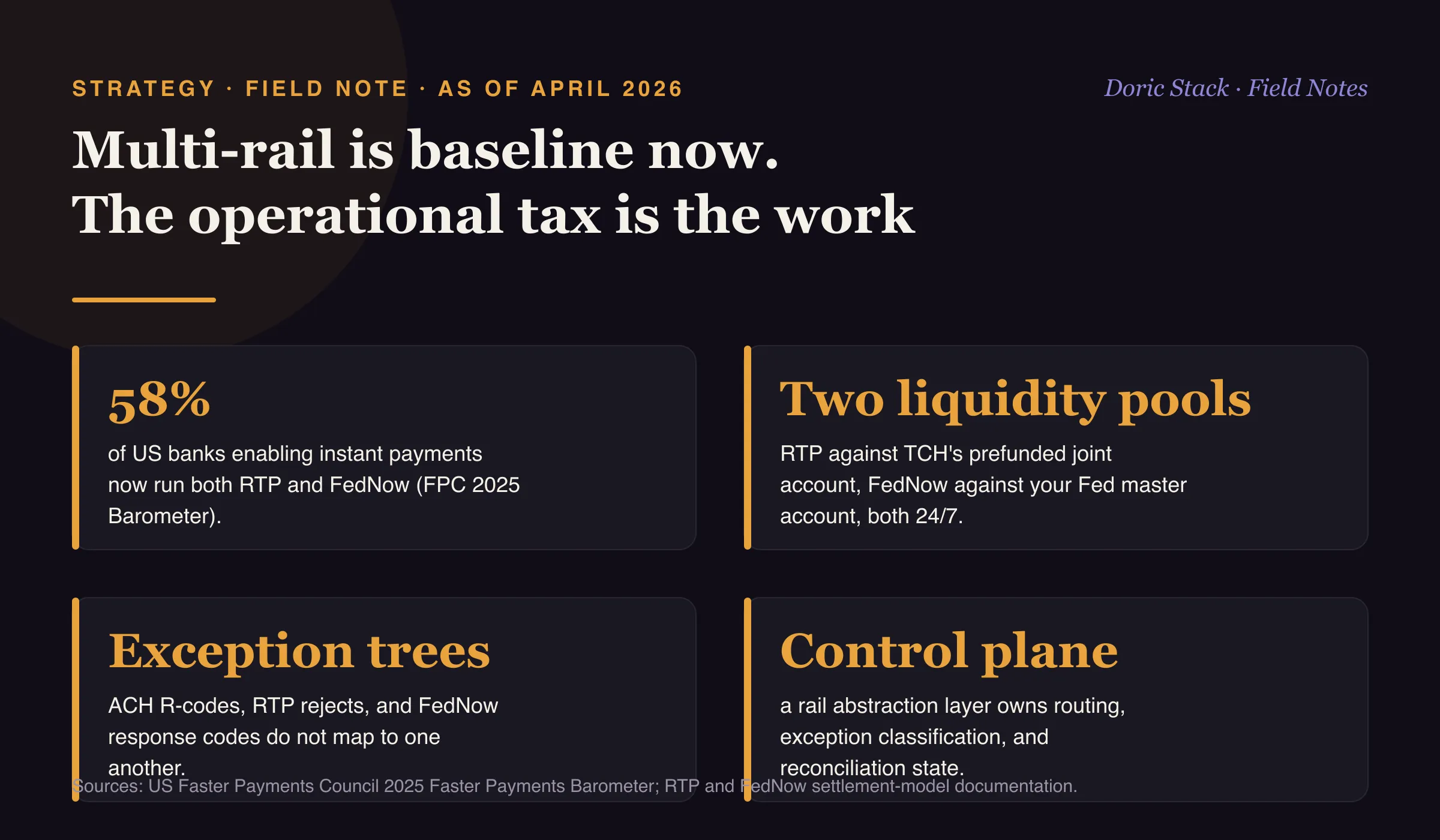
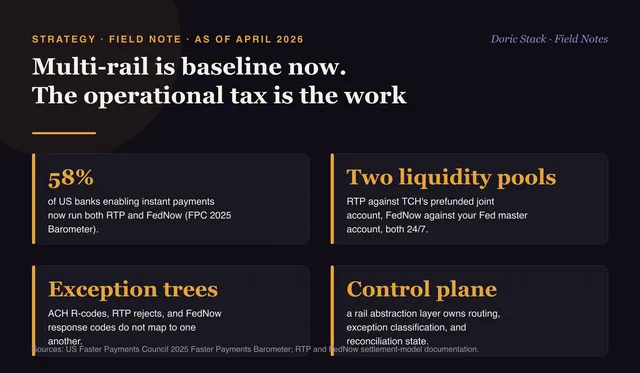
Multi-rail is baseline now, the operational tax is the work (as of April 2026): per the US Faster Payments Council's 2025 Faster Payments Barometer, 58 percent of US banks enabling instant payments now run both RTP and FedNow; the two rails use different liquidity models, with RTP settling against The Clearing House's prefunded joint account and FedNow against each participant's Fed master account, both 24/7; ACH return codes, RTP reject reasons, and FedNow response codes do not map to one another; and the architectures that scale share a rail abstraction layer that owns routing, exception classification, and reconciliation state.
A dashboard that says settled and a customer who says it never arrived - across two rails with two finality models.

Adoption

58%

of US banks enabling instant payments now run both RTP and FedNow (FPC 2025 Barometer).

Liquidity

Two pools

RTP against TCH's prefunded joint account, FedNow against your Fed master account, both 24/7.

Exceptions

No shared map

ACH return codes, RTP rejects, and FedNow response codes do not map to one another.

A control plane, not a router

The architectures that scale share one pattern: a rail abstraction layer that owns routing, exception classification, and reconciliation state. It is a control plane, not a switch statement, and it is what makes two rails behave like one to the customer.

What the layer has to own

It has to translate between exception vocabularies so an operator sees one classification, not three code sets. It has to keep a live position across two liquidity pools that never close, so reconciliation is a moving target rather than an end-of-day file. And it has to make the routing decision per transaction, in milliseconds, against cutoffs, limits, beneficiary preference, and each rail’s capability. Build that once, centrally, and the operational complexity of multi-rail stops leaking onto the customer and the ops floor. In the instant-payments deployments I have seen reach production, this is the dividing line between the banks that scale and the ones that firefight.
Was this useful?

Choose once.

Related Posts

View All Posts »
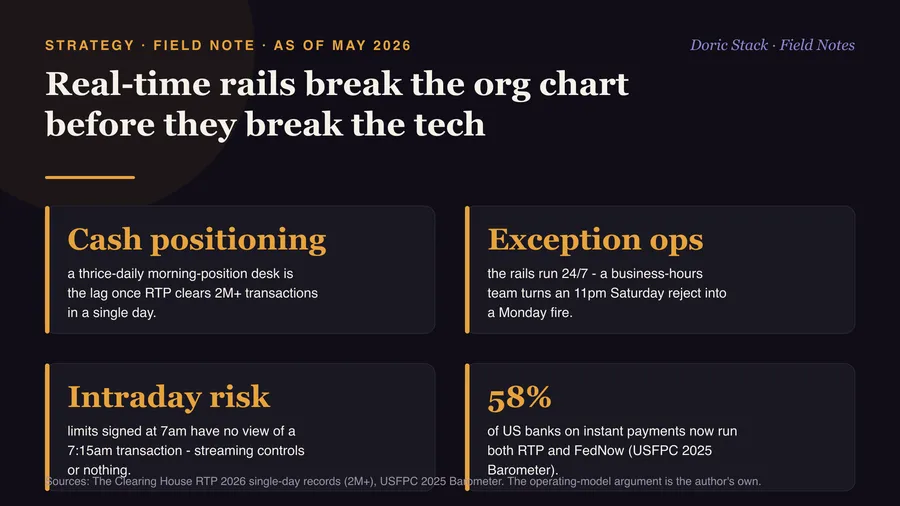
Real-time payments break your treasury org chart before they break your tech

Real-time payments break your treasury org chart before they break your tech

Your real-time rails settle in fifteen seconds. Your treasury org chart was built around an end-of-day cutoff. The gap between them is where the next reconciliation loss lives, and it shows up in three roles - cash positioning, exception ops, and intraday risk - long before it shows up in the tech stack.

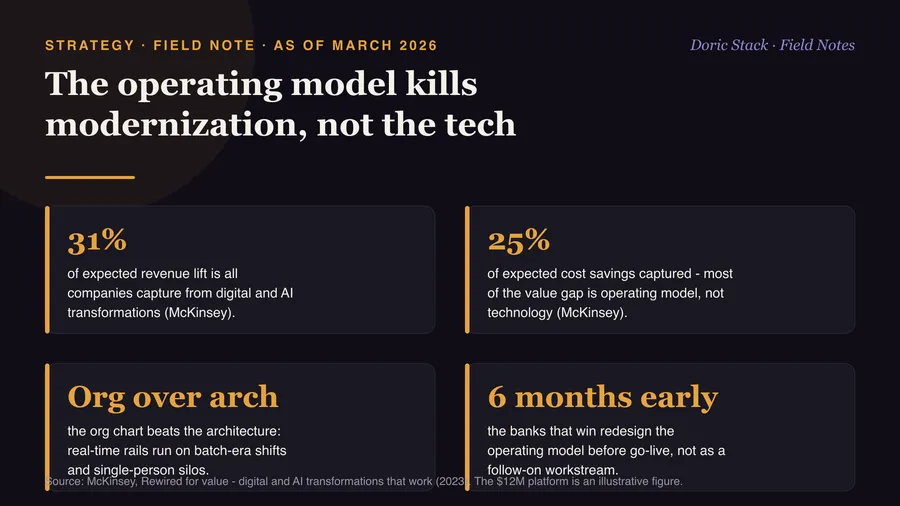
The operating model kills payment modernization, not the tech

The operating model kills payment modernization, not the tech

A bank buys a modern payment platform and keeps the 2019 team structure, the same escalation matrix, the same three-person on-call rotation. The platform ships daily. The governance model says 90 days. Most modernization failures are operating-model failures, and the org chart defeats the architecture every time.

Wire investigations become structured workflows

Wire investigations become structured workflows

A wire investigation is the moment confidence breaks - the payment has moved and the clock is running. The Fedwire Funds Service changes planned for November 2026 turn investigation messages into structured workflows and add a Create Payment Return feature. Treat it as a rail feature, not a back-office patch.

Design open banking for the rule that keeps moving

Design open banking for the rule that keeps moving

The CFPB finalized US open banking under Section 1033 in October 2024, a federal court enjoined enforcement a year later, and the rule is now back in reconsideration. The data layer that survives that whiplash is the deliverable, not the API. Build for reversals, not launch day.