Field note

Design open banking for the rule that keeps moving

The CFPB finalized US open banking under Section 1033 in October 2024, a federal court enjoined enforcement a year later, and the rule is now back in reconsideration. The data layer that survives that whiplash is the deliverable, not the API. Build for reversals, not launch day.

Dec 22, 2025 · Navin Agrawal · Strategy · 3 min read

Design open banking for the rule that keeps moving

Visual brief

Visual brief

Design open banking for the rule that keeps moving

As of December 2025

The CFO message lands before the first coffee: why did our finance app lose bank data overnight? The app did nothing wrong. The rule changed.

US open banking was finalized under CFPB Section 1033 in October 2024, then a court enjoined enforcement a year later, and it is now back in reconsideration. That is not legal trivia. It hits treasury first, where a data-access pause breaks payment runs and reconciliation long before the legal memo reaches operations.

What actually happened

Three dates, often blurred. The CFPB finalized the Personal Financial Data Rights rule under Section 1033 on October 22, 2024. On October 29, 2025, a federal court in Kentucky issued a preliminary injunction barring the CFPB from enforcing it, pending the agency’s own revised rulemaking - the rule was enjoined, not struck down. And the CFPB had already reopened the rulemaking earlier in 2025, so the rule sits on the books, unenforceable, while the terms are rewritten.

Why it lands on you

Your data layer was built against a rule that is now moving. If third-party access pauses, the payment runs that depend on it fail, reconciliation breaks, and vendor trust erodes - all of it downstream of a legal change you did not make and cannot control.

Finalized

Oct 22 2024

CFPB finalized the Personal Financial Data Rights rule under Section 1033 (US open banking).

Enjoined

Oct 29 2025

a federal court barred enforcement pending the CFPB reconsideration - the rule was not vacated.

Status

Reconsidered

the CFPB reopened the rulemaking in 2025, so the rule stands on the books but is unenforceable for now.
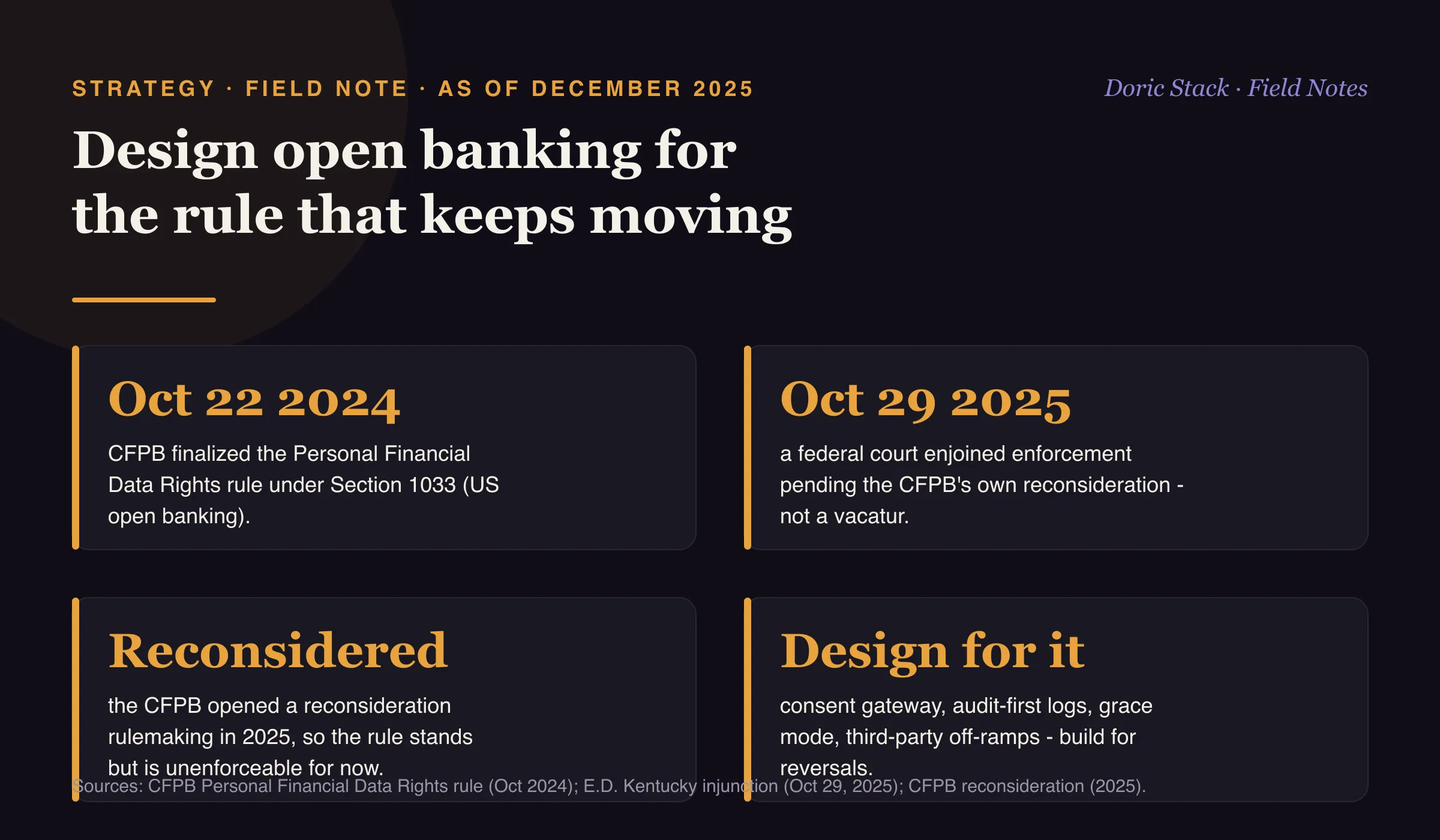
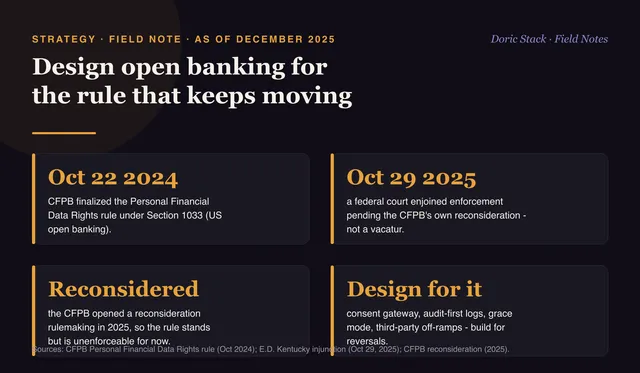
Design open banking for the rule that keeps moving (as of December 2025): the CFPB finalized the Personal Financial Data Rights rule under Section 1033 on October 22, 2024; on October 29, 2025 a federal court enjoined enforcement pending the CFPB's own reconsideration, rather than vacating the rule; the CFPB reopened the rulemaking in 2025, so the rule stands but is unenforceable for now; and the design answer is a consent gateway, audit-first logs, a grace mode, and third-party off-ramps - built for reversals, not launch day.
The rule moved twice in a year. The data layer that survives that is the one designed to absorb a rule change.
The real deliverable is not the API. It is a data layer that stays reliable when the rulebook moves - and if it cannot absorb a rule change, it breaks exactly when finance needs it most.
Was this useful?

Choose once.

Related Posts

View All Posts »
Variable recurring payments reset the subscription rail

Variable recurring payments reset the subscription rail

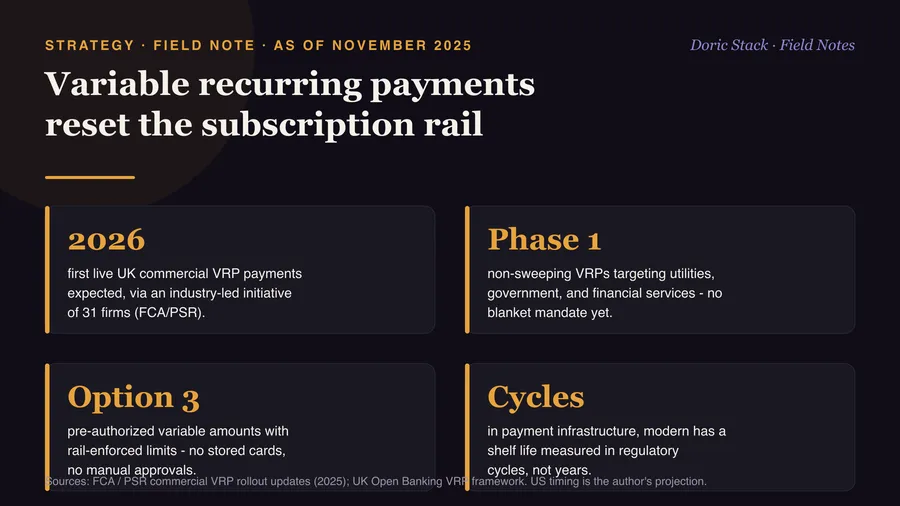
Subscription billing has two bad options today - store the card or chase a manual approval every cycle. Variable recurring payments add a third: pre-authorized variable amounts with limits enforced by the rail. The UK is building it now, and the lesson for everyone else is about regulatory cycles, not technology.

Real-time payments break your treasury org chart before they break your tech

Real-time payments break your treasury org chart before they break your tech

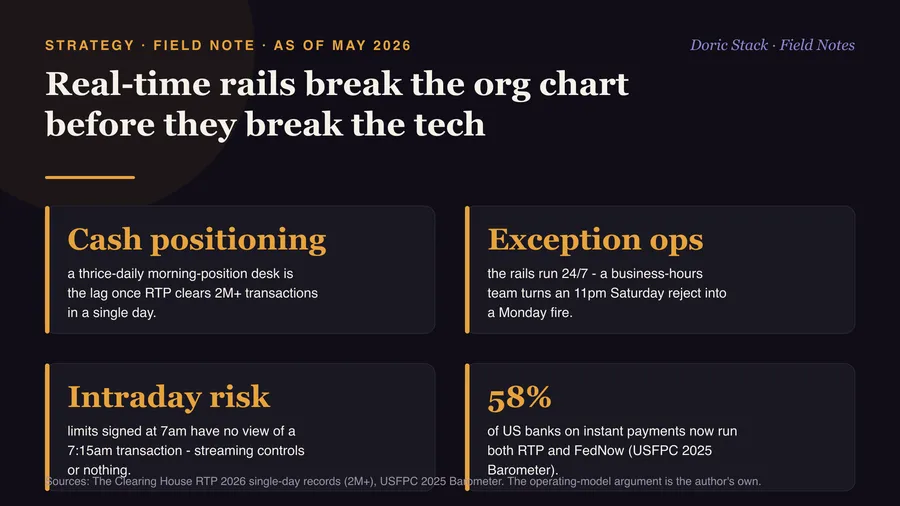
Your real-time rails settle in fifteen seconds. Your treasury org chart was built around an end-of-day cutoff. The gap between them is where the next reconciliation loss lives, and it shows up in three roles - cash positioning, exception ops, and intraday risk - long before it shows up in the tech stack.

Multi-rail is baseline now. The operational tax is the work

Multi-rail is baseline now. The operational tax is the work

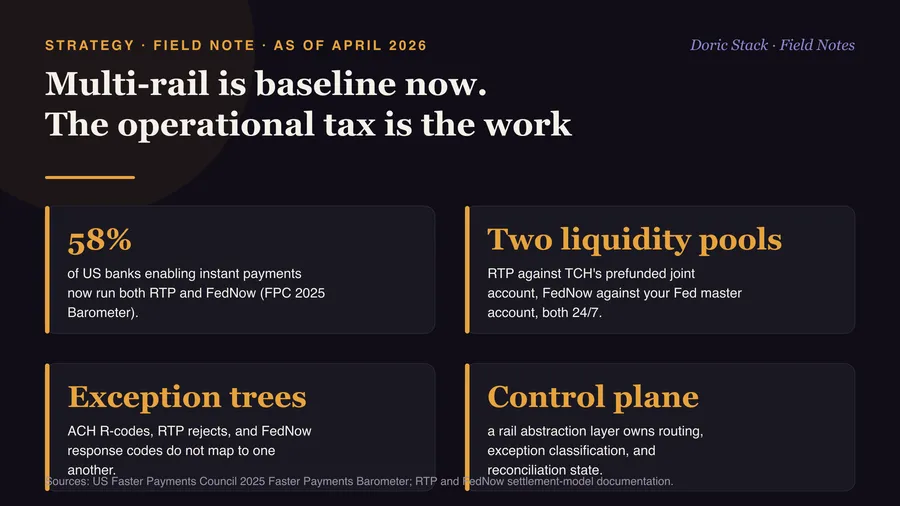
The multi-rail debate is over - most US banks enabling instant payments now run both RTP and FedNow. The cost moved from the strategy deck to the operations floor, where exception handling becomes a decision tree, reconciliation becomes real-time position-keeping across two liquidity models, and routing is a per-transaction decision in milliseconds.

The operating model kills payment modernization, not the tech

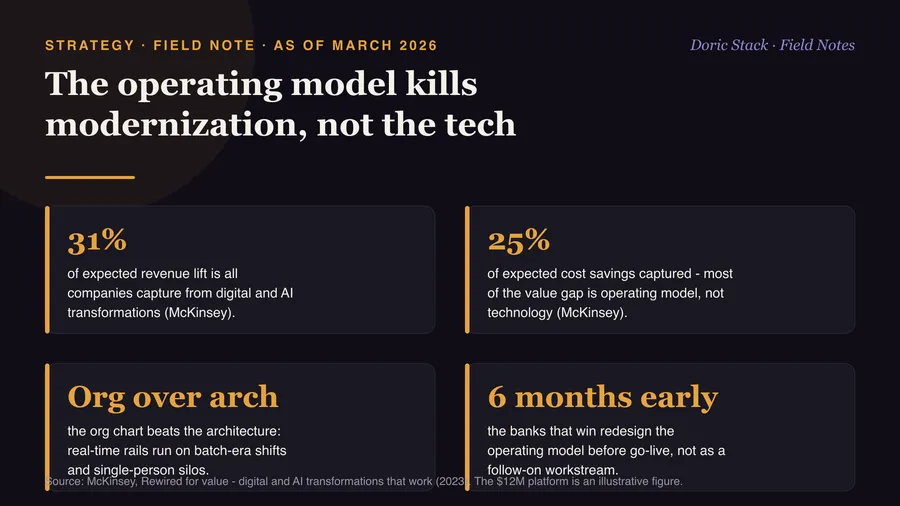
The operating model kills payment modernization, not the tech

A bank buys a modern payment platform and keeps the 2019 team structure, the same escalation matrix, the same three-person on-call rotation. The platform ships daily. The governance model says 90 days. Most modernization failures are operating-model failures, and the org chart defeats the architecture every time.