Field note

Euro payments now name-check the payee before they move

Since October 2025, euro credit transfers run a Verification of Payee check before they settle, and a name-IBAN mismatch triggers an alert. It hits US treasuries paying EUR vendors and payroll as hard as it hits EU banks, and the same name checks are a fair bet to reach FedNow and RTP next.

Dec 15, 2025 · Navin Agrawal · Strategy · 3 min read

Euro payments now name-check the payee before they move

Visual brief

Visual brief

Euro payments now name-check the payee before they move

As of December 2025

Euro payments now name-check you before they move. Since October 2025, a euro credit transfer runs a Verification of Payee check against the payee's name and IBAN, and a mismatch returns an alert before the money goes.

This is a euro-area obligation on the banks, but the operational hit travels. A US treasury paying EUR vendors, payroll, or marketplaces feels it the moment a supplier name in the ERP does not match what the receiving bank holds.

What actually went live

Two dates, often blurred into one. The European Payments Council’s VoP scheme rulebook took effect on October 5, 2025, setting the bank-to-bank messaging standard. Four days later, on October 9, the EU Instant Payments Regulation made offering VoP mandatory for payment service providers in the euro area. The check runs on every euro credit transfer, instant or standard, and returns a Match, Close Match, No Match, or “not possible” result that the payer sees before deciding to proceed.

Why a US treasury feels it

The obligation sits with the euro-area bank, not the foreign payer, but the failure shows up in your run. A EUR payment lands at a euro correspondent, becomes a SEPA credit transfer, and the VoP check fires there. If your supplier master does not mirror the bank’s record, the payment slows or stalls, and authorized-push-payment fraud only falls when someone actually actions the alerts rather than waving them through.

Now live

Oct 2025

EPC VoP scheme rulebook took effect Oct 5, and the IPR made it mandatory for euro-area PSPs from Oct 9.

Scope

Every euro CT

instant or standard, gets a Match, Close Match, or No Match name check before it moves.

Who decides

The payer

sees the result and chooses - proceeding on a mismatch shifts liability to the payer.
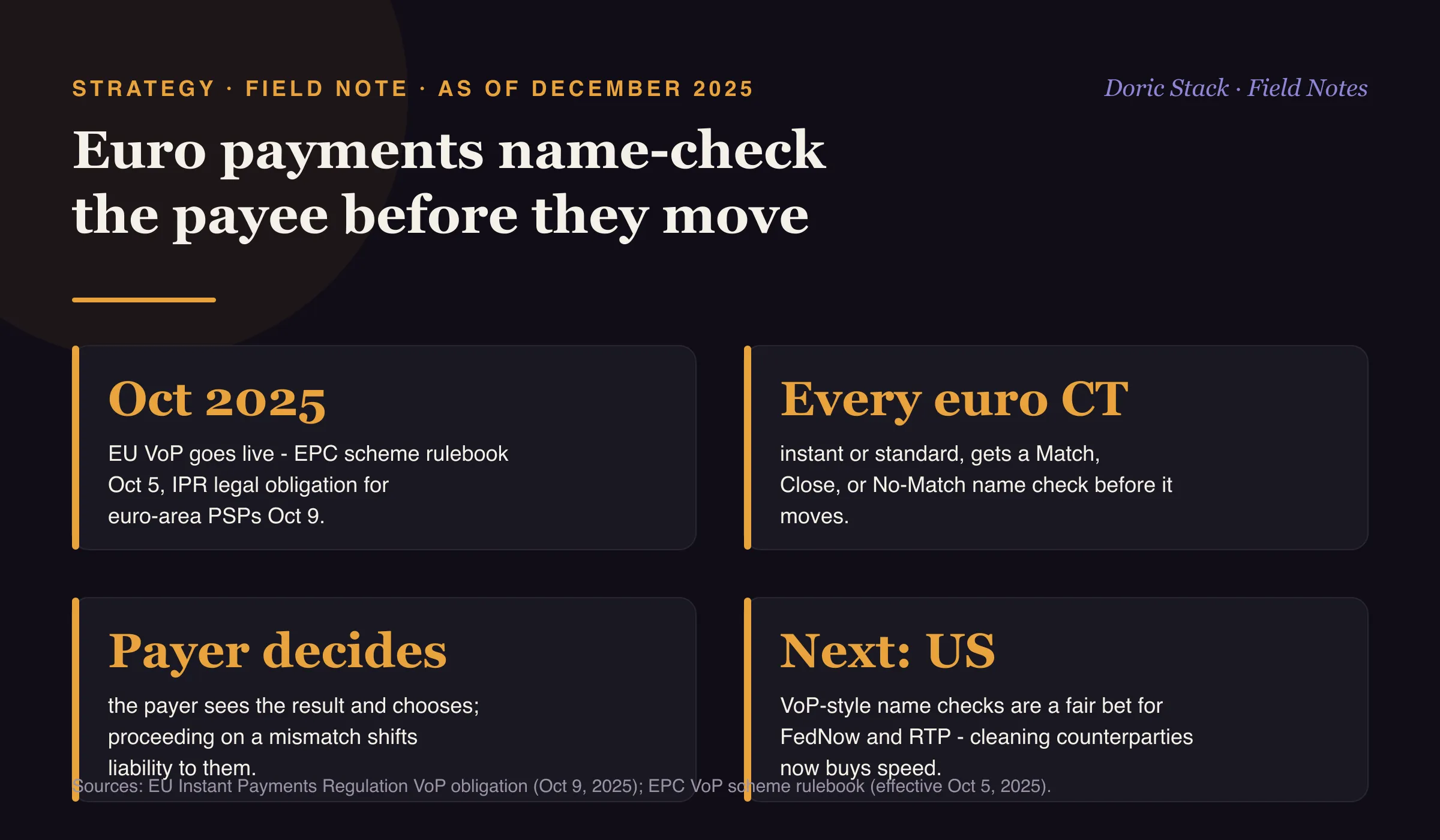
Euro payments name-check the payee before they move (as of December 2025): the European Payments Council VoP scheme rulebook took effect October 5, 2025, and the EU Instant Payments Regulation made VoP mandatory for euro-area payment service providers from October 9; every euro credit transfer, instant or standard, gets a Match, Close Match, or No Match name check before it moves; the payer sees the result and chooses, and proceeding on a mismatch shifts liability to the payer; and VoP-style name checks are a fair bet to reach FedNow and RTP next.
The name check now sits in front of the money. Whether it adds speed or friction depends on how clean your counterparty data is.
If your controls move slower than the payment, the rail will decide for you. Clean the counterparty data and build the alert lane before the same check lands at home.
Was this useful?

Choose once.

Related Posts

View All Posts »
The operating model kills payment modernization, not the tech

The operating model kills payment modernization, not the tech

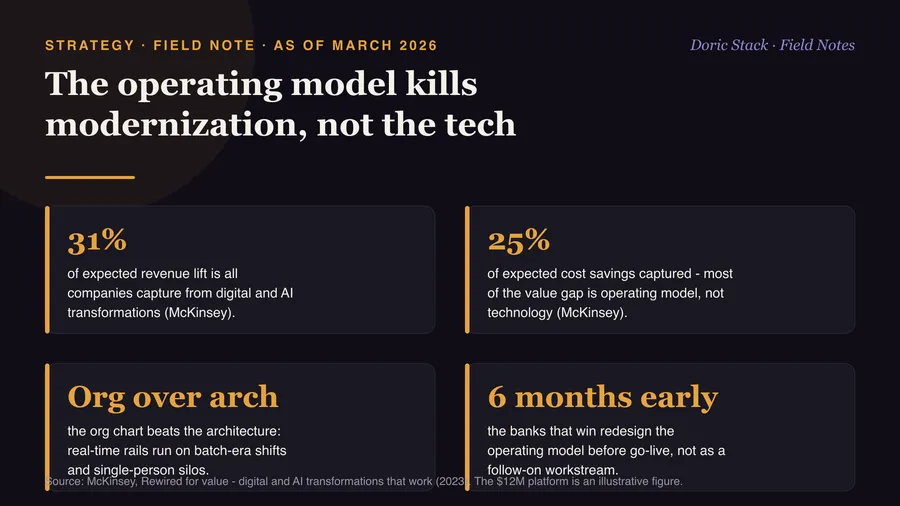
A bank buys a modern payment platform and keeps the 2019 team structure, the same escalation matrix, the same three-person on-call rotation. The platform ships daily. The governance model says 90 days. Most modernization failures are operating-model failures, and the org chart defeats the architecture every time.

Variable recurring payments reset the subscription rail

Variable recurring payments reset the subscription rail

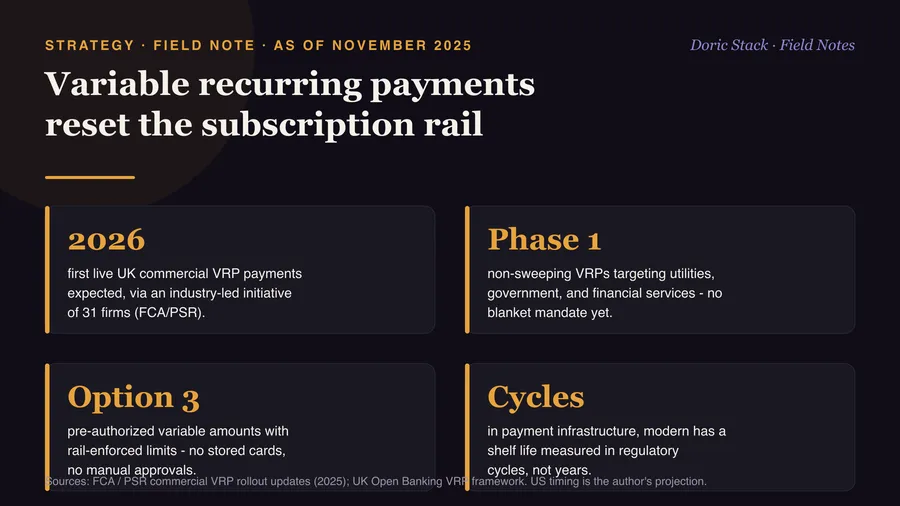
Subscription billing has two bad options today - store the card or chase a manual approval every cycle. Variable recurring payments add a third: pre-authorized variable amounts with limits enforced by the rail. The UK is building it now, and the lesson for everyone else is about regulatory cycles, not technology.

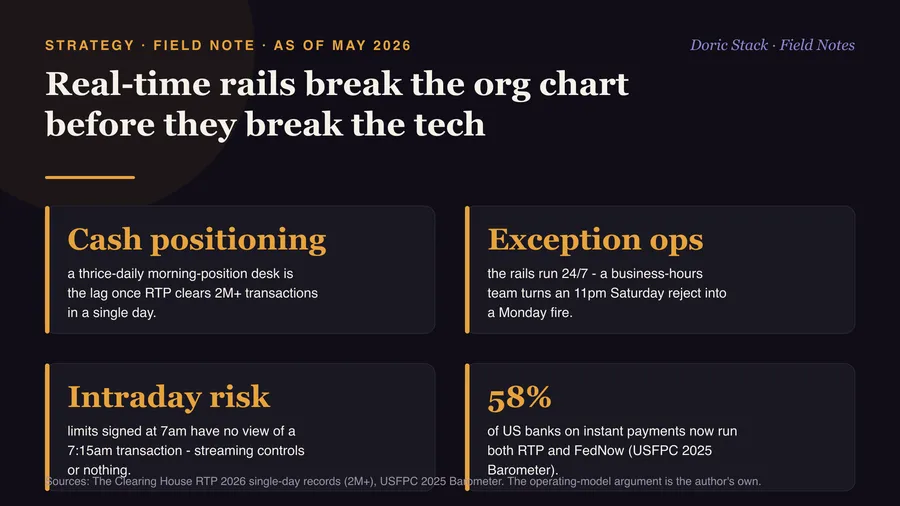
Real-time payments break your treasury org chart before they break your tech

Real-time payments break your treasury org chart before they break your tech

Your real-time rails settle in fifteen seconds. Your treasury org chart was built around an end-of-day cutoff. The gap between them is where the next reconciliation loss lives, and it shows up in three roles - cash positioning, exception ops, and intraday risk - long before it shows up in the tech stack.

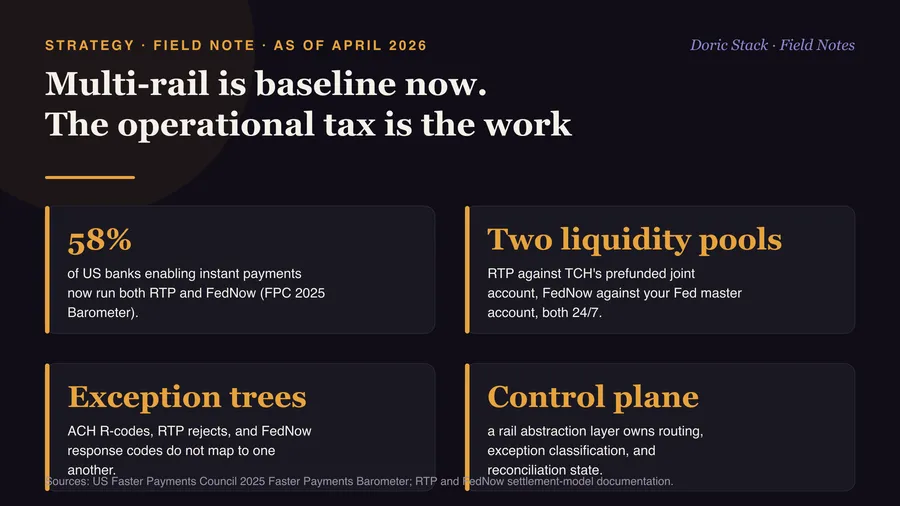
Multi-rail is baseline now. The operational tax is the work

Multi-rail is baseline now. The operational tax is the work

The multi-rail debate is over - most US banks enabling instant payments now run both RTP and FedNow. The cost moved from the strategy deck to the operations floor, where exception handling becomes a decision tree, reconciliation becomes real-time position-keeping across two liquidity models, and routing is a per-transaction decision in milliseconds.